
Trenchless Pipe Lining St. Louis Homeowners Trust
If your sewer line is cracked, leaking, or invaded by tree roots, you don’t have to dig up your yard to fix it. Maplewood Plumbing repairs damaged sewer pipes from the inside using trenchless pipe lining (also known as CIPP lining) to restore the line without tearing up landscaping, driveways, or sidewalks. We’ve been doing sewer work in St. Louis for over 40 years, and pipe lining is one of the most cost-effective fixes available when it’s the right call for your line.
Family-owned, licensed and insured, with a one-year workmanship warranty plus a 10-year manufacturer’s warranty on every successfully installed liner. Call 314-645-6350 or fill out a service request form today!
What is Pipe Lining?
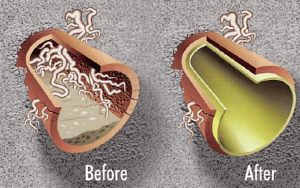
Pipe lining is a trenchless method for repairing damaged sewer pipes without excavation. We feed a flexible liner saturated with epoxy resin into the existing pipe through a single access point, then cure the resin in place using either UV light or controlled heat. Once cured, the liner becomes a new pipe inside the old one. It is sealed against the existing walls and just as structurally strong as a fresh installation.
This process is also called CIPP lining, short for cured-in-place pipe lining, and it’s the same technology municipal water authorities use to rehabilitate major underground infrastructure. The result is a sealed, root-resistant pipe with a working lifespan of 50 years or more, installed without the disruption of digging up your property.
Our Different Pipe Lining Methods
Every sewer line is a little different. The right repair method depends on the pipe itself, including its diameter, length, available access points, and the type of damage you’re dealing with. We use three different approaches and select the one that fits the job.
Pull-in-Place (PIP)
The pull-in-place method uses two access points: one to feed the liner in and another to pull it through. The liner is saturated with epoxy and pulled into position before curing. This is a strong option for situations where two access points are available and the line geometry supports it.
Inversion Method
The inversion method requires only one access point. The liner is inverted as it’s pushed into the pipe, pressing the epoxy against the pipe walls as it goes. Up to 200 feet of liner can be installed in a matter of seconds with this method, making it especially useful for longer runs.
LightRay UV
The newest and fastest of the three. UV light cures the liner in minutes rather than hours, typically requiring a single access point. Best for most residential sewer laterals.
NEW! LightRay UV Pipe Lining
LightRay UV is the newest pipe lining technology in our service lineup, and it’s a significant step forward from traditional CIPP methods. Instead of curing the liner with hot water, steam, or ambient air, which can take hours, LightRay uses ultraviolet light to cure the epoxy resin in a fraction of the time, often less than an hour for a typical residential lateral.
The process is straightforward. We feed an epoxy-saturated bladder into the damaged pipe through a single above-ground access point; usually a clean-out, a toilet drain, or the vertical stack on your roof. The bladder is inflated with air pressure, the UV lights are switched on, and the resin cures in place against the pipe walls. Once it’s set, we deflate and remove the bladder. The pipe is sealed, the yard is untouched, and your sewer line is back in service, often in a single afternoon.
For most damaged residential sewer lines in St. Louis, this is now the method we recommend first.
When Pipe Lining is the Right Solution
Pipe lining works when the existing pipe is damaged but structurally intact enough to host a liner. That covers a lot of common St. Louis sewer problems: cracks, longitudinal fractures, root intrusion, corroded cast iron, leaking joints, and pipes with normal age-related deterioration. Most clay and cast iron sewer laterals in older St. Louis homes are good candidates.
Pipe lining doesn’t work when the pipe has fully collapsed, when joints have shifted out of alignment severely, when the diameter is too small to accommodate a liner, or when the damage is so widespread that there’s not enough pipe left to bond to. In those cases, traditional excavation is the right call.
The only way to know for sure is a sewer camera inspection. We run a camera down the line, identify the type and extent of the damage, and tell you straight whether lining is the right fix or whether you’d be better off with a different approach. No upsell, no guesswork.
How Our Pipe Lining Process Works
Here’s what to expect from the time you call:
- We start with a sewer camera inspection to see what’s actually going on inside the line. You’ll see where the damage is, how extensive it is, and whether the pipe is a candidate for lining.
- You get a written estimate before any work begins. No vague verbal quotes. No surprise charges added later. You see the price first.
- We install the liner using whichever method fits the line. For LightRay UV, that’s typically a single access point, an inflated bladder, and a UV curing cycle. For PIP or inversion, the setup is slightly different, but the principle is the same; epoxy liner into the damaged pipe, cured in place against the walls.
- We run a camera through the cured line to verify the installation before we leave. You see the results on screen.
Every successfully installed liner is backed by our one-year warranty on workmanship plus a 10-year manufacturer’s warranty on the liner itself.
Most pipe lining projects start with a camera inspection. Give us a call or book online and we’ll come find out exactly what’s going on inside your sewer line before recommending anything.
Why St. Louis Homeowners Choose Maplewood Plumbing
40+ years serving the metro area
We’ve been doing sewer work in St. Louis City and County since the 1980s. We know the neighborhoods. We know the cast iron lateral lines in city homes built before the 1960s and the clay sewer pipes in older County subdivisions. We’ve seen what fails, why, and what the right fix looks like.
Family-owned and locally operated
We’re not a franchise, and we’re not a national chain rebranded with a local name. When you call us, you get the same local team your neighbors call.
No subcontractors, no handoffs
The licensed plumber who runs the camera is the one who installs the liner. The work doesn’t get passed off to another crew or another company.
Written estimates, always
You know what you’re paying before we start.
1-year workmanship warranty & 10-year manufacturer’s warranty
Every successfully installed pipe liner is double-warrantied. If something isn’t right after we leave, we come back and make it right.
Financing available
Sewer line work is rarely a planned expense. If cost is the holdup, we can work with you.
See a Pipe Lining Job From Start to Finish
The two videos below are from one of our recent St. Louis pipe lining jobs. The first shows what the camera found inside the damaged sewer line, the kind of cracks and root intrusion most older St. Louis homes will eventually deal with. The second shows the same pipe after we installed the liner, fully sealed and ready for another 50 years of service. Same line, same day.