

You noticed your drains are slow. Maybe your toilet gurgles when you run the bathroom sink, or there’s a faint sewage smell coming from the floor drain in your basement. You’ve snaked it twice in the past year and it keeps coming back. Sound familiar?
If your home was built before 1970, there’s a good chance tree roots are the culprit, and in St. Louis, that describes a lot of homes. Thousands of homeowners are dealing with aging clay sewer pipes and mature tree canopies that have been quietly working against each other for decades. The result is one of the most common (and most misunderstood) plumbing problems in the city.
What Are Tree Roots Doing in Your Sewer Line?
Most homeowners picture tree roots as something that stays close to the trunk. In reality, tree roots are opportunistic and can extend 20 to 30 feet or more in search of water and nutrients. Your sewer line offers both in abundance.
Here’s how the process works: sewer pipes carry warm, nutrient-rich wastewater, and even a well-maintained pipe releases small amounts of moisture vapor through joints, aging seals, and hairline cracks. That vapor escapes into the surrounding soil, and tree roots — which are constantly growing and sensing their environment — follow it directly back to the source.
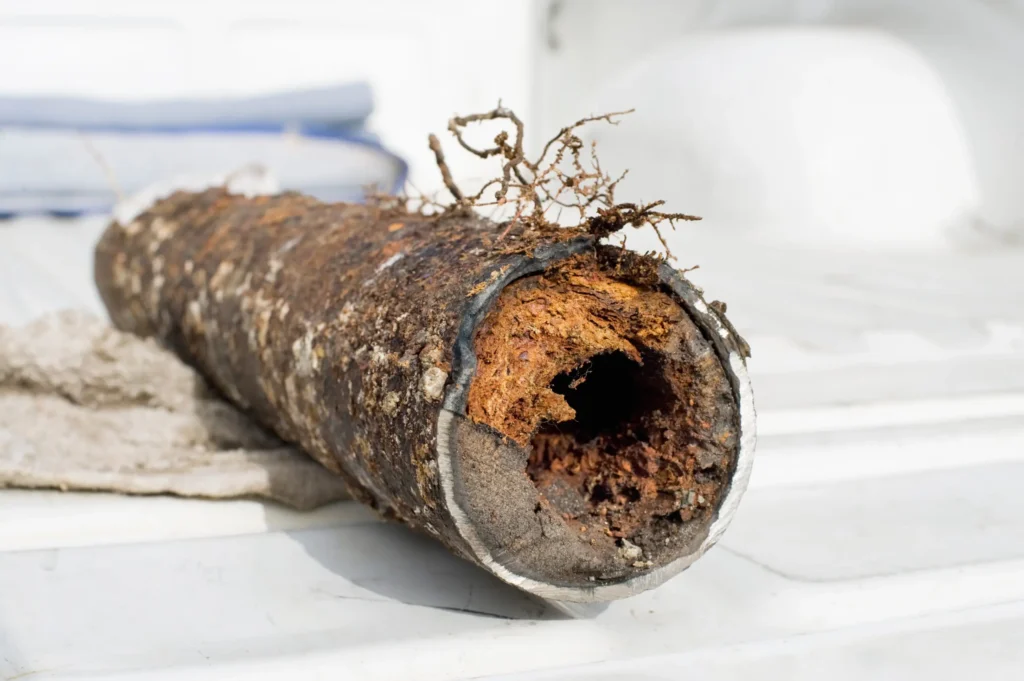
Once a fine root tip finds an opening, even a microscopic crack or a slightly separated joint, it squeezes through. Inside the pipe, it finds a continuous supply of water and nutrients and begins growing aggressively. A single thread of root eventually becomes a dense mass of fibrous growth that restricts flow, catches debris, and can ultimately block the pipe entirely. In severe cases, the expanding root mass exerts enough pressure to crack the pipe wider or cause sections to collapse.
The timeline from first intrusion to full blockage can range from a couple of years to over a decade depending on tree species, pipe condition, and soil moisture levels. That’s why so many homeowners are caught off guard. By the time symptoms appear, root growth is often well established.
Which Trees Are the Worst Offenders?
Not all trees pose the same level of risk. The biggest threats to St. Louis sewer lines are species with aggressive, moisture-seeking root systems:
- Silver Maple: One of the most common street trees in St. Louis and one of the most destructive to sewer lines. Fast-growing, shallow roots that spread wide.
- Weeping Willow: Known for roots that actively seek water sources, including pipes.
- Cottonwood and Poplar: Fast-growing with expansive root systems.
- American Elm: Common in older St. Louis neighborhoods; roots spread broadly and deeply.
- Birch: Water-loving roots that seek out moisture actively.
- Ash and Sweetgum: Less aggressive but still capable of intrusion, especially in aging clay pipe.
It’s worth noting that you don’t need a large tree directly over your sewer line for this to happen. A neighbor’s willow or a street-side silver maple 20 feet away can absolutely reach your lateral. Proximity to the trunk matters, but it’s not the only factor.
Why St. Louis Homes Are Especially Vulnerable
St. Louis has a higher-than-average rate of root intrusion problems compared to newer cities, and the reason comes down to three overlapping factors.
Aging clay pipe infrastructure
A huge percentage of St. Louis homes were built between 1900 and 1960. The original sewer laterals in these homes are clay pipe, which was the standard material of the era. Clay pipe was built to last 50 to 75 years. Many of these pipes are now 70 to 100+ years old. Clay pipe doesn’t fail all at once; it deteriorates slowly, developing cracks and joint separations that are initially invisible but provide exactly the entry points roots are looking for.
A mature urban tree canopy
Older neighborhoods have older trees. That silver maple that shades your front porch has been growing since before your house was built, and its root system extends far beyond what’s visible above ground.
Clay soil
Much of the St. Louis region sits on dense clay soil that shifts seasonally as it absorbs and releases moisture. This movement can stress pipe joints over time, accelerating the development of cracks and separations (and making root intrusion more likely.)
The combination of these three factors means that root intrusion in St. Louis is not really a question of if — for older homes with original clay laterals, it’s a question of when and how bad.
7 Warning Signs of Tree Root Intrusion in Your Sewer Line
Root intrusion rarely announces itself with a dramatic failure. It develops slowly, and the early symptoms are easy to dismiss or blame on other causes. Knowing what to look for can mean the difference between a relatively simple clearing and a full line replacement.
1. Slow Drains Throughout the House
A single slow drain usually indicates a localized clog in that fixture’s trap or branch line. When multiple drains throughout the house are slow at the same time (sinks, tubs, toilets, floor drains), the problem is almost certainly in the main sewer line. Root intrusion is one of the most common causes.
2. Gurgling Sounds from Toilets and Drains
If you hear gurgling or bubbling from your toilet when you run water somewhere else in the house (or from drains when the toilet flushes) that’s trapped air being forced through a partial blockage. It’s a classic sign of a restricted main line.
3. Recurring Clogs That Keep Coming Back
If you’ve had your drain snaked and it keeps blocking again within a few months, roots are the likely explanation. A drain snake can punch through a root mass and restore flow, but it rarely removes the roots completely. They regrow, often faster than before, since the pipe is still providing the water and nutrients they’re after.
4. Sewage Odors from Drains or Yard
A foul smell coming from floor drains, toilets, or from the ground near your cleanout can indicate that sewage isn’t flowing properly and is sitting somewhere in the line. If you notice an unexplained sewage smell in your yard, especially after rain, that’s a more serious sign that a pipe may be cracked or leaking underground.
5. Wet Spots, Sunken Areas, or Unusually Green Grass in the Yard
When roots crack a pipe severely enough to allow sewage to leak into the surrounding soil, the nutrients in that sewage can create a tellingly lush or green patch of grass directly over the pipe. You might also notice soft or sunken ground, or a wet area in the yard that doesn’t correspond to recent rainfall.
6. Multiple Fixtures Backing Up at Once
If sewage backs up into a tub when you flush the toilet, or if flushing the toilet causes water to come up in a floor drain, you have a significant blockage in the main sewer line. This is a plumbing emergency that requires same-day service.
7. Sewage Backup in the Basement
The lowest fixture in your home (often a basement toilet or floor drain) is the first place sewage will back up when the main line is blocked. Finding sewage in your basement is the most urgent warning sign on this list. If this is happening, stop using water in the house and call a plumber immediately.
What Happens If You Ignore Tree Root Intrusion?
The progression of an untreated root intrusion follows a predictable path, and each stage is more expensive to address than the one before it:
Stage 1: Early intrusion
A small mass of roots has entered through a crack or joint. Flow is slightly restricted. You may not notice any symptoms yet, or drains may be very mildly slow. At this stage, hydro jetting can clear the roots with minimal cost and disruption.
Stage 2: Established growth
Root mass has grown significantly and is creating noticeable flow restriction. Recurring clogs and slow drains are common. Hydro jetting plus pipe lining may be appropriate depending on pipe condition.
Stage 3: Significant blockage
The root mass is large enough to cause regular backups and potentially trap paper and debris. The pipe itself may show cracks or joint damage. Lining or lateral repair/replacement becomes necessary.
Stage 4: Pipe failure
Root pressure or root-accelerated deterioration has caused pipe collapse, severe cracking, or complete joint separation. Sewage is leaking into the soil. Excavation and full line replacement are typically required. The further along the progression, the more disruptive and expensive the solution.
How Tree Root Intrusion Is Diagnosed
Before recommending any repair, Maplewood Plumbing always begins with a sewer camera inspection. We insert a high-definition video camera into your line through a cleanout or access point and transmit a real-time view of the entire pipe, from your home all the way to the city main connection.
This is the only way to know with certainty what’s happening inside your sewer line. The camera inspection reveals:
- Presence and severity of root intrusion: from fine hair-like roots just beginning to enter, to a dense, fully-packed root ball
- Exact location of the problem: we can pinpoint the issue on the surface above, so we know exactly where to dig if excavation is needed
- Condition of the pipe itself: cracks, joint separations, collapsed sections, bellying (low spots where water pools), corrosion
- Other contributing issues: grease buildup, offset joints, debris accumulation
Many homeowners are surprised to discover that what seemed like a recurring clog is actually an established root intrusion that’s been developing for years. Others find that a suspected root problem is actually a collapsed pipe section. The camera shows you exactly what’s there, and that information determines which repair approach makes the most sense.
Which Repair Options Are Right for You?
The right repair depends on the severity of the root growth, the structural condition of the pipe, and the layout of your property. Here’s a detailed breakdown of the options, from least to most invasive.
Clearing the Line
What it is
Hydro jetting uses water pressurized up to 4,000 PSI to blast through root masses and thoroughly clean the inside of the pipe.
How it works
A specialized nozzle is fed into the line through a cleanout. The high-pressure water stream cuts through root masses, flushes out debris, and scours the pipe walls clean, something a drain snake can’t do. After jetting, we run the camera again to confirm the line is fully clear.
When it’s the right choice
Hydro jetting is ideal when roots have entered the pipe but haven’t caused significant structural damage. It’s also used as part of the preparation process before pipe lining, since lining requires a completely clean pipe surface.
What it won’t do
Hydro jetting removes roots but doesn’t repair the cracks or joint gaps that allowed roots to enter. Without addressing the underlying pipe condition, roots will regrow, often within 12 to 24 months. For pipes that show structural damage, jetting should be paired with lining or repair.
How it compares to snaking
A drain snake creates a small pathway through a clog but leaves root debris and buildup behind. Hydro jetting clears the full diameter of the pipe and removes root material entirely, providing significantly longer-lasting results.
Restoring the Pipe Without Digging
What it is
Trenchless pipe lining, also called cured-in-place pipe (CIPP), creates a new pipe inside the existing one using an epoxy-saturated liner that is inserted and then cured in place.
How it works
After the pipe is cleaned with hydro jetting, a flexible liner coated with epoxy resin is inserted through an above-ground access point (typically a cleanout or toilet drain). The liner is inflated to press against the pipe walls, and the resin is cured using heat or UV light. Once cured, the result is a smooth, seamless pipe within the old pipe that seals all existing cracks and gaps against future root entry.
The LightRay UV method
Maplewood Plumbing uses LightRay UV curing technology, which cures the liner rapidly and precisely using ultraviolet light. It’s faster and more controlled than traditional steam curing methods.
When it’s the right choice
Pipe lining is ideal when the pipe has cracks, deteriorating joints, or other structural damage that allowed roots to enter, but the pipe hasn’t collapsed. It’s one of the most cost-effective solutions for aging clay pipe because it rehabilitates the line completely without digging up your yard, driveway, or landscaping.
The benefits
- No excavation required (access is made through a single above-ground point)
- Same structural strength as a new pipe
- Seals the pipe against future root intrusion
- Improves flow (smoother interior surface than original clay)
- Backed by a 1-year installation warranty and 10-year manufacturer’s warranty
- Preserves your landscaping, driveway, and hardscape
When it’s not appropriate
Severely collapsed sections, extreme pipe offsets, or situations where the pipe wall is too deteriorated to support a liner may require excavation and replacement instead. The camera inspection determines whether lining is a viable option.
Pipe Repair and Replacement
What it is
Sewer lateral work addresses the pipe that runs from your home to the city main, or the section that is entirely the homeowner’s responsibility. When the lateral has suffered damage beyond what lining can address, the affected sections (or the full line) need to be repaired or replaced.
When it’s the right choice
Collapsed sections, severe pipe offsets, major joint separations, or extensive root damage that has compromised the pipe’s structural integrity are all situations where repair or replacement is needed rather than lining.
What to expect
Maplewood Plumbing handles every aspect of sewer lateral work in-house. From the initial camera inspection through repair, excavation if needed, and final restoration, the same team is accountable for the entire job. We’ve been doing sewer lateral work in St. Louis since 1985 and understand the specific challenges of our city’s aging clay pipe infrastructure.
Common sewer lateral issues we address:
- Collapsed clay pipe sections
- Root infiltration with joint separation
- Cracked or scaling pipe walls
- Bellied pipe (sections that have sunk, creating low spots where debris accumulates)
- Complete pipe failure
- Joint separation from soil movement
Excavation for When Direct Access Is Required
What it is
When pipe replacement requires physical access to the underground line, excavation services are used to open the ground, remove and replace the affected section of pipe, and restore the surface.
When it’s the right choice
Collapsed pipe, severely offset joints that can’t be lined, sections where the pipe has sunk or shifted significantly, or situations where direct access is needed for repair (these all may require excavation.)
Modern excavation vs. the old way
Traditional sewer repair meant large-scale trenching that destroyed landscaping, driveways, and sidewalks and left homeowners without water for two to three days. Modern excavation techniques are far more precise and targeted. Maplewood Plumbing works to minimize the footprint of any excavation and performs complete site restoration once the work is done.
What’s included
Our excavation services cover the full project, including locating the problem, digging, pipe replacement, backfilling, and surface restoration. All work is done in-house with no subcontractors.
What You Can Do To Prevent Tree Root Intrusion
No solution eliminates the risk of root intrusion entirely (especially in older homes with clay laterals and mature trees) but there are several steps homeowners can take to reduce risk and catch problems early.
Schedule a Sewer Camera Inspection Proactively
If your home was built before 1970 and you’ve never had a camera inspection, schedule one before a problem develops. This is particularly important if you’re planning to buy an older home, a pre-purchase sewer inspection can reveal issues that a standard home inspection misses entirely. Knowing the condition of your lateral before closing can save you from a significant surprise repair.
Know What’s in the Ground
Understanding where your sewer lateral runs helps you make better decisions about landscaping and tree placement. If you’re not sure where your line runs, we can help you locate it during an inspection.
Be Strategic About Landscaping
Avoid planting willows, silver maples, cottonwoods, birches, or poplars anywhere near your sewer line. If you’re working with a landscaper, let them know the general path of your lateral. Smaller ornamental trees and deep-rooted species with more compact root systems (like ornamental cherries or crabapples) pose far less risk.
Consider Pipe Lining as Preventive Protection
If your camera inspection shows an aging clay lateral that’s still structurally sound but showing signs of wear — minor cracks, degrading joints — having it lined before roots find their way in is a sound preventive investment. The new epoxy liner seals the pipe completely and adds decades of service life.
Enroll in a Drain Maintenance Plan
Maplewood Plumbing offers drain maintenance plans that include periodic camera inspections and cleanings. Routine maintenance catches developing root intrusion during a scheduled visit.
Use Root-Inhibiting Foaming Products Carefully
There are foaming root-kill products (copper sulfate-based and dichlobenil-based formulations) designed to be flushed into sewer lines to slow root regrowth after clearing. These can be useful as a supplementary measure after hydro jetting, but they are not a substitute for proper inspection and repair. They don’t remove established root masses, restore damaged pipe, or seal cracks against re-entry.
The Bottom Line About Root Damage to Sewer Lines
Tree root intrusion is one of the most common plumbing problems — and one of the most preventable when caught early. The combination of aging clay pipe, a mature tree canopy, and St. Louis’s clay soil creates real risk for any home built before 1970.
The good news is that modern solutions, like hydro jetting, trenchless pipe lining, and precision sewer lateral repair, mean that even significant root intrusion can be addressed without the massive excavation projects that used to be standard. The right solution depends on what a camera inspection reveals, and getting that inspection is always the right first step.
Maplewood Plumbing has been solving sewer problems in St. Louis homes since 1985. We handle every aspect of root intrusion diagnosis and repair in-house. Camera inspections, hydro jetting, pipe lining with LightRay UV technology, sewer lateral repair, and full excavation when needed. No subcontractors. No finger-pointing. Just 40+ years of St. Louis plumbing expertise, backed by transparent pricing and a commitment to getting it right.
If your drains are slow, your toilet is gurgling, or you’ve had recurring clogs, call 314-645-6350 for same-day service throughout the St. Louis metro area.
Frequently Asked Questions About Tree Roots & Sewer Lines
Can tree roots damage pipes even if the tree is far from the house?
Yes. Tree roots, particularly from water-seeking species like willows and silver maples, can extend 20 to 30 feet or more from the trunk. A large tree on the edge of your property or even a neighbor’s lot can absolutely reach your sewer lateral.
How long does it take for roots to completely block a sewer line?
It depends on the tree species, the size of the initial opening, and soil conditions. In ideal conditions for root growth, a minor intrusion can become a significant blockage within two to five years. In some cases, particularly with fast-growing species and aging clay pipe, it can happen faster.
Is hydro jetting enough, or do I also need pipe lining?
Hydro jetting clears existing roots but doesn’t seal the cracks or joint gaps that let roots in. If those entry points remain open, roots will regrow. For pipes that show structural damage pipe lining after hydro jetting seals the pipe against future intrusion and is the more permanent solution.
How often do roots grow back after hydro jetting?
Without any preventive treatment, roots typically begin regrowing within 12 to 24 months after hydro jetting. With root-inhibiting foam applied after jetting, regrowth can be slowed. Pipe lining eliminates the root entry points entirely and provides the longest-lasting protection.
My home has PVC or ABS pipe, am I still at risk?
Newer plastic pipe is more resistant to root intrusion than aging clay because it doesn’t develop the cracks and joint separations that give roots their entry points. However, joints and connections can still be vulnerable over time, particularly if the pipe was improperly installed or has experienced movement. Clay pipe in pre-1970 homes remains the highest-risk scenario.
Will homeowners insurance cover tree root damage to sewer lines?
Most standard homeowners insurance policies do not cover sewer line damage caused by tree root intrusion, as it is considered gradual deterioration rather than a sudden event. Some policies have optional sewer line coverage as an endorsement. It’s worth reviewing your policy and asking your agent about options — especially if you have an older home with original clay pipe!
I have a pre-purchase inspection scheduled. Should I also get a sewer inspection?
Yes, and we strongly recommend it. Standard home inspections typically don’t include a sewer camera inspection, and older St. Louis homes with clay laterals can have significant issues that aren’t visible without one. A few hundred dollars before closing is excellent protection against a multi-thousand-dollar surprise after it.
Comments are closed